7 AI Updates That Redefined Assistants, Chatbots and Cloud Agents
Want articles like this for your own video to promote it on YouTube and Google? Order them through the Telegram bot @sat_sit_bot. It writes articles around your video, embeds the video and publishes them on popular niche websites (no ads). Free trial — 50 articles.
· based on the channel Paul J Lipsky
Key takeaways
- Grok Bot is being positioned as a hub that can call on Claude, Midjourney and Suno instead of relying on a single model.
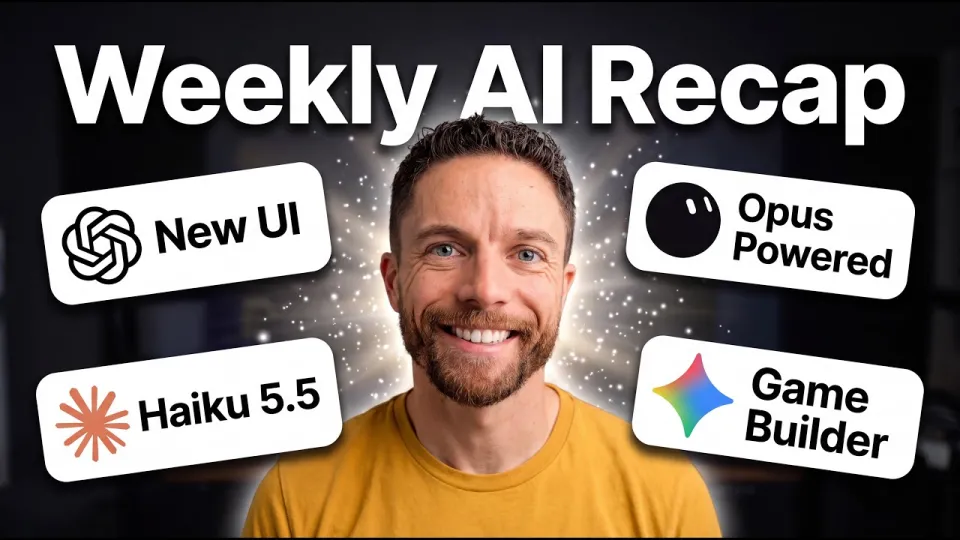
- ChatGPT is rolling out an Intelligent UI that changes how the assistant presents tools and results rather than just its look.
- Anthropic's Claude Cowork is shifting to the cloud, turning a desktop-style collaboration tool into a hosted agent workspace.
- Google is adjusting Gemini subscription plans while releasing image tooling such as Nano Banana 2.1 and the Google Playground test.
- The weekly recap comes from Paul J Lipsky, whose audience is pressing for a beginner-friendly Claude Code walkthrough.
AI news this week is dominated by one theme: assistants are turning into orchestrators. Grok Bot is being pitched as a hub that can pull in Claude, Midjourney and Suno, ChatGPT is getting an Intelligent UI, and Claude Cowork is moving to the cloud — while Google reshuffles Gemini plans and image tools. The full breakdown aired in the weekly recap from Paul J Lipsky, and viewers who want to try the workflow tooling shown alongside it can register through Okou.
Grok Bot wants to be the front door to Claude, Midjourney and Suno
The headline item is that Grok Bot is no longer framed as a single-model chatbot but as a dispatcher that can route work to other services. The recap describes a plan for Grok Bot to use Claude, Midjourney and Suno — a language model for reasoning and writing, an image generator for visuals, and a music generator for audio — from inside one assistant surface.
That matters because it changes what a chatbot subscription actually buys. Instead of comparing raw model quality, users start comparing orchestration: which assistant can call the right specialist tool, keep context across steps, and hand back a finished asset. A viewer described handing Grok Bot a shared folder of business videos, giving instructions for a social clip, receiving a voice script, recording it, and getting back a result the viewer rated above paid work. Whether or not that experience generalizes, it illustrates the promise: the assistant becomes a producer, not an answer box.
The practical caveats are the usual ones for multi-tool agents. Access to third-party models depends on licensing and plan tier, outputs still need human review, and permissions matter when an agent is pointed at a photo library or a drive. Anyone experimenting should start with a low-stakes folder, keep originals untouched, and check what the bot can read before granting access.
ChatGPT's Intelligent UI changes the interface, not just the skin
ChatGPT's new Intelligent UI is the second big thread: the assistant is being redesigned so the interface adapts to the task instead of showing the same chat box for everything. In practice that means surfaces that surface the right controls — canvases, generated artifacts, tool panels — depending on whether you are writing, coding, analyzing data or producing media.
The direction is consistent with where the product has been heading: less typing into a blank field, more structured output you can edit in place. For teams, the interesting question is whether a smarter UI reduces prompt engineering overhead or simply hides it. A UI that guesses intent well saves time; one that guesses wrong adds clicks. Expect a transition period where long-time users relearn where features live.
Claude Cowork moves from the desktop to the cloud
Anthropic's Claude Cowork is shifting to the cloud, which turns a locally oriented collaboration experience into a hosted workspace where agents can run tasks without a user's machine staying online. The recap covers the move as part of Anthropic's broader push toward agents that do work rather than describe it.
Cloud hosting solves real problems: long-running jobs survive a closed laptop, shared team access gets simpler, and state lives in one place. It also raises the questions that always follow cloud agents — data residency, what gets logged, who can see a workspace, and how costs scale when agents run unattended. For small teams the trade-off is usually worth it; for regulated environments, the review comes first.
There is also a naming wrinkle worth flagging. Anthropic's model line has been iterating quickly, and the recap's tags reference Claude Haiku 5.5 alongside Cowork — a reminder that version numbers in this space move faster than most documentation. Confirm the exact model and tier in the product before budgeting around a specific name.
Google adjusts Gemini plans and pushes image tooling
Google's segment covers two things at once: changes to Gemini subscription plans and new creative tooling. The recap mentions Gemini plan changes, Nano Banana 2.1 for image generation and editing, and a hands-on test of Google Playground.
Plan changes are the part users feel most. Bundled storage, model access tiers and which features sit behind which subscription determine whether an upgrade is worth it — and one viewer noted that a higher storage tier also unlocks access to Google's pro model, a detail worth checking on the official pricing page rather than assuming. Image tooling is where Google has been most competitive lately: iterative editing, character consistency and fast turnaround are the features that decide whether designers keep a second tool open.
The Playground test is the useful reality check. Demos show best-case outputs; a hands-on run shows latency, guardrails and how much prompt fiddling a good result actually takes.
OpenAI's quieter but consequential moves
Beyond the interface redesign, the OpenAI segment of the recap covers product and platform adjustments that matter more to builders than to casual users. The pattern across recent releases is consolidation: fewer separate endpoints and surfaces, more capability packed into the main assistant and its API tiers.
For anyone shipping on top of these models, the checklist stays constant — pin model versions where possible, watch deprecation notices, and keep an evaluation set so a silent upgrade does not quietly change output quality. The same discipline applies to the UI changes: if your workflow depends on a specific interaction pattern, test it after each rollout.
What the audience is actually asking for
The comment thread under the recap is a decent proxy for where non-specialist users are stuck. Three themes dominate.
- Claude Code for non-technical people. The most-liked request by far is a beginner walkthrough of Claude Code — what it is, how to install it, and what a first useful task looks like without a computer science background.
- Onboarding confusion around new bots. One viewer deleted a newly appeared "primary" bot assuming something had gone wrong, then could not restore it. New agent surfaces appearing without explanation is a real UX failure, not user error.
- Format appreciation. Multiple commenters say the day-by-day structure is what makes the weekly firehose manageable — a signal that chronology beats topic grouping when the news is this dense.
If you are in the first group, the practical starting point is to treat an agent like a junior colleague: give it a scoped folder, a clear deliverable, and a review step. Do not hand it your entire drive on day one.
How to evaluate these releases without getting swept up
A simple filter helps when every week brings a new orchestration story. Ask three questions of any assistant update: what can it now do end to end, what does it cost at your actual usage level, and what happens to your data when it does it.
Grok Bot's multi-tool routing scores well on the first question and needs scrutiny on the second and third. ChatGPT's Intelligent UI is mostly a first-question change. Claude Cowork's cloud move is a second- and third-question change. Google's plan shuffle is almost entirely the second. Sorting news this way keeps the hype cycle from dictating your stack.
Conclusion
The through-line this week is consolidation: one assistant calling many specialists, one interface adapting to many tasks, one workspace moving to the cloud, one subscription bundling more. The winners will be decided less by benchmark scores and more by whether the orchestration is trustworthy, affordable and legible to normal users. Paul J Lipsky's weekly recap is a useful place to track that shift week over week, especially for viewers who want the day-by-day version rather than a topic-by-topic summary. If the tooling covered alongside the recap is relevant to your workflow, you can start with Okou.
Questions & answers
Can Grok Bot really use Claude, Midjourney and Suno at the same time?
The recap describes a plan to route tasks from Grok Bot to those external services, with Claude handling language work, Midjourney images and Suno audio. Actual availability will depend on plan tier and licensing arrangements, so check the current feature list before relying on it. Treat early demos as direction rather than a guarantee.
What is different about ChatGPT's Intelligent UI?
It is a redesign of how the assistant presents tools and results rather than a cosmetic refresh. Instead of one uniform chat box, the interface adapts to the task with structured surfaces and controls. Expect a relearning period as features move location.
Why does moving Claude Cowork to the cloud matter?
Cloud hosting lets agent tasks keep running when your laptop is closed and makes shared team access simpler. The trade-offs are data residency, logging and cost control when agents run unattended. Regulated teams should review those before adopting.
Is a higher Gemini plan worth it for model access?
Plan tiers bundle storage, features and model access, so the value depends on which of those you actually use. A viewer pointed out that a larger storage tier also unlocked access to Google's pro model. Verify the current bundles on the official pricing page rather than trusting summaries.
Source: Weekly AI Recap: GrokBot Just Did the Unthinkable, ChatGPT Looks Completely Different & More! · Markdown version