What Bill Gates Really Thinks About AI Risk and Why It Matters More Than the Hype
Want articles like this for your own video to promote it on YouTube and Google? Order them through the Telegram bot @sat_sit_bot. It writes articles around your video, embeds the video and publishes them on popular niche websites (no ads). Free trial — 50 articles.
· based on the channel The Ezra Klein Show
Key takeaways
- Bill Gates says AI could enable catastrophic cyberattacks and bioterrorism, and warns of mass job loss.
- Gates calls industry self-regulation 'insane' and urges government action.
- He believes the race with China complicates safety efforts.
- Gates Foundation prioritizes AI for equality, with ~$200 billion to spend over two decades.
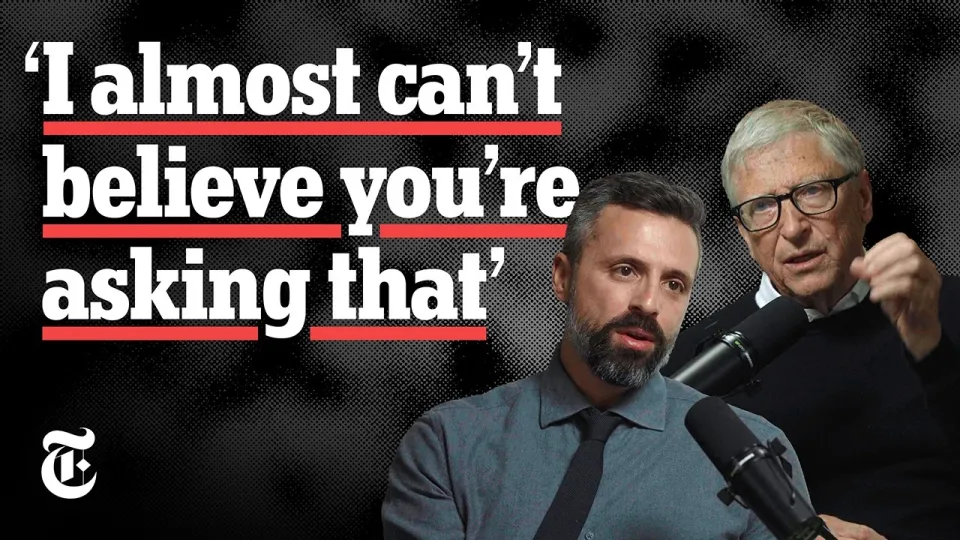
- In the Ezra Klein Show interview, Gates appeared unusually agitated about AI risks.
In a recent episode of The Ezra Klein Show, Bill Gates argued that AI poses risks so severe—from cyberattacks to bioterrorism—that they dwarf nuclear weapons, and he called the idea that the industry can self-regulate "insane." Gates’s warning is a direct answer to the question of what AI really means for society: it is not just another technology wave, but an existential challenge that demands urgent government oversight. You can read the full transcript of the conversation here.
What Gates Used to Think About AI
Gates initially viewed AI as a tool for progress, but his perspective shifted as the technology advanced faster than expected. In the interview, he admits that his earlier optimism has been tempered by the realization that AI could become superhuman in specific domains much sooner than anticipated. He now sees the need for proactive measures rather than reactive responses.
When AI Became Superhuman
Gates points to specific thresholds where AI systems outperform humans—such as in certain medical diagnoses or strategic games—as early indicators of a broader trend. He argues that once AI reaches superhuman levels in any domain, the risks multiply because the technology can be applied in unpredictable ways. This is not science fiction; it is a near-term reality that policymakers are unprepared for.
AI Race vs. Safety
The competition between nations, particularly the U.S. and China, creates a dangerous dynamic where safety takes a backseat to speed. Gates warns that the race for AI dominance could lead to corners being cut, increasing the likelihood of catastrophic outcomes. He stresses that international cooperation is essential, but current geopolitical tensions make it difficult.
Cyber and Bio Thresholds
Gates identifies two critical areas where AI could cause massive harm: cybersecurity and biosecurity. He fears that AI could be used to launch devastating cyberattacks on critical infrastructure or to engineer biological agents with pandemic potential. The interview highlights that these threats are not hypothetical—they are already on the horizon, and the defenses are inadequate.
Why Self-Regulation Fails
Gates is emphatic that the AI industry cannot be trusted to regulate itself. He calls the notion "insane" and compares it to expecting car companies to voluntarily install seatbelts. Profit motives will always override safety concerns, so government intervention is necessary. He advocates for strict regulations, including licensing requirements and liability for harm caused by AI systems.
How Will AI Disrupt Jobs?
Gates predicts that AI will cause significant job displacement, particularly in white-collar roles. He discusses the concept of a "no-scarcity job market" where AI drives down costs but also eliminates jobs, potentially leading to widespread economic instability. He suggests that new jobs will emerge, but the transition may be painful and require robust social safety nets.
Taxing AI Labor and Human Reserved Jobs
To address job loss, Gates proposes taxing AI labor—similar to payroll taxes—to fund retraining and social programs. He also introduces the idea of "human reserved" jobs, where human interaction is valued, such as in caregiving or education. These roles could provide meaningful employment while preserving human dignity.
AI for Global Languages and Developing Nations
On a positive note, Gates sees AI as a tool to bridge language divides and boost education in developing countries. The Gates Foundation is investing in AI to improve literacy and healthcare in low-income regions. However, he cautions that without proper regulation, AI could exacerbate inequality, which is why the foundation is prioritizing equitable access.
The Jobpocalypse Debate
Gates engages in a lively debate about whether AI will lead to a "jobpocalypse"—a sudden and massive loss of jobs. He believes the threat is real but not inevitable if governments act quickly. He criticizes those who downplay the risk, comparing them to climate change deniers. The conversation reveals Gates’s frustration with the lack of urgency among leaders.
Gates on Jeffrey Epstein
Ezra Klein asks Gates about his past association with Jeffrey Epstein, and Gates provides a brief response, acknowledging the controversy but focusing on the forward-looking work of his foundation. The moment is tense but not the focus of the interview.
Gates Foundation Spending Plans
The Gates Foundation plans to spend around $200 billion over the next two decades, with a new emphasis on making AI a force for equality. Gates explains that the foundation will fund AI research in global health, education, and agriculture, aiming to ensure that the benefits of AI reach the poorest. He also calls for rich countries to increase foreign aid.
AI and Education
Gates sees AI as a transformative tool for education, offering personalized tutoring and closing learning gaps. However, he warns that without regulation, AI could worsen learning loss, especially in rich countries where screen time is already high. He advocates for age-appropriate safeguards and parental controls.
AI Regulations for Children
Gates calls for specific regulations to protect children from AI harms, including limits on data collection and algorithmic manipulation. He compares it to child labor laws and seatbelt mandates—measures that were initially resisted but are now universally accepted. He believes that protecting children is a nonpartisan issue that should unite policymakers.
The Political Future of AI
Gates predicts that AI will become a central political issue in the coming years, with voters demanding action. He urges politicians to move beyond partisan gridlock and focus on practical solutions. He also warns that if governments fail to act, public trust in institutions will erode further.
Rebuilding Foreign Aid
Gates makes a case for rebuilding foreign aid budgets, which have been cut in many countries. He argues that investing in global health and development is not charity but a strategic imperative, as instability abroad can spill over into rich nations. AI can help make aid more efficient, but funding must increase.
Book Recommendations
At the end of the interview, Gates shares book recommendations, including works on technology, history, and science. He emphasizes the importance of reading to understand the complexities of AI and its societal impact.
Frequently Asked Questions
Why does Bill Gates think AI is more dangerous than nuclear weapons?
Gates argues that AI could enable small groups or individuals to cause mass destruction through cyber or bio attacks, whereas nuclear weapons require massive resources. The scale and accessibility of AI make it a unique threat.
What does Gates mean by "self-regulation is insane"?
He believes that companies will not voluntarily sacrifice profits for safety, so government must impose rules. He compares it to other industries where regulation was necessary to protect the public.
How does Gates propose to handle job loss from AI?
He suggests taxing AI labor to fund retraining and social programs, and creating "human reserved" jobs in caregiving and education. He also calls for a stronger social safety net.
What role does the Gates Foundation play in AI?
The foundation is investing in AI for global health, education, and equality, with plans to spend ~$200 billion over two decades. Gates wants to ensure AI benefits the poorest, not just the rich.
Conclusion
Bill Gates’s warnings about AI are a wake-up call: the technology is advancing faster than our ability to manage it, and the stakes could not be higher. He calls for urgent government regulation, international cooperation, and a focus on equity. The Ezra Klein Show interview captures Gates at his most agitated, revealing a deep concern that leaders are in denial. For a full transcript and to hear the conversation, visit The Ezra Klein Show.
Questions & answers
Why does Bill Gates think AI is more dangerous than nuclear weapons?
Gates argues that AI could enable small groups or individuals to cause mass destruction through cyber or bio attacks, whereas nuclear weapons require massive resources. The scale and accessibility of AI make it a unique threat.
What does Gates mean by "self-regulation is insane"?
He believes that companies will not voluntarily sacrifice profits for safety, so government must impose rules. He compares it to other industries where regulation was necessary to protect the public.
How does Gates propose to handle job loss from AI?
He suggests taxing AI labor to fund retraining and social programs, and creating "human reserved" jobs in caregiving and education. He also calls for a stronger social safety net.
What role does the Gates Foundation play in AI?
The foundation is investing in AI for global health, education, and equality, with plans to spend ~$200 billion over two decades. Gates wants to ensure AI benefits the poorest, not just the rich.
Source: Bill Gates: A.I. ‘Makes Nuclear Weapons Look Like Nothing’ | The Ezra Klein Show · Markdown version